一、简介
wireshark官网获取源代码解读。
二、Wireshark功能模块
下图给出了wireshark功能模块: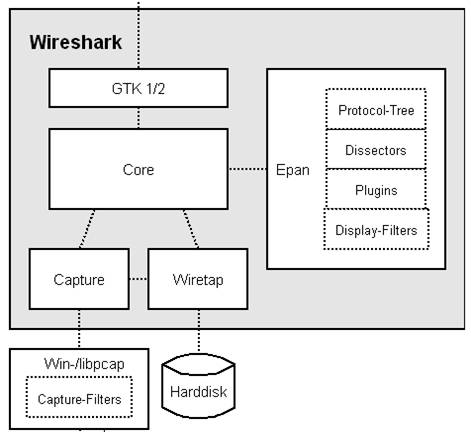
GTK1/2
处理用户的输入输出显示,源码在gtk目录.Core
核心模块,通过函数调用将其他模块连接在一起,源码在根目录Epan
wireshark Packetage Analyzing,包分析引擎,源码在epan目录
- Protocol-Tree:保存数据包的协议信息,wireshark的协议结构采用树形结构,解析协议报文时只需要从根节点通过函数句柄依次调用各层解析函数即可。
- Dissectors:在epan/dissector目录下,各种协议解码器,支持700+种协议解析,对于每种协议,解码器都能识别出协议字段(field),并显示出字段值(field value)由于网络协议种类很多,为了使协议和协议间层次关系明显,对数据流里的各个层次的协议能够逐层处理,wireshark系统采用了协议树的方式。
- Plugins:一些协议解码器以插件形式实现,源码在plugins目录
- Display-Filters:显示过滤引擎,源码在epan/dfilter目录
Capture
捕包引擎,利用libpcap/WinPcap从底层抓取网络数据包,libpcap/WinPcap提供了通用的抓包接口,能从不同类型的网络接口(包括以太网,令牌环网,ATM网等)获取数据包。Wiretap
从文件中读取数据包,支持多种文件格式,源码在wiretap目录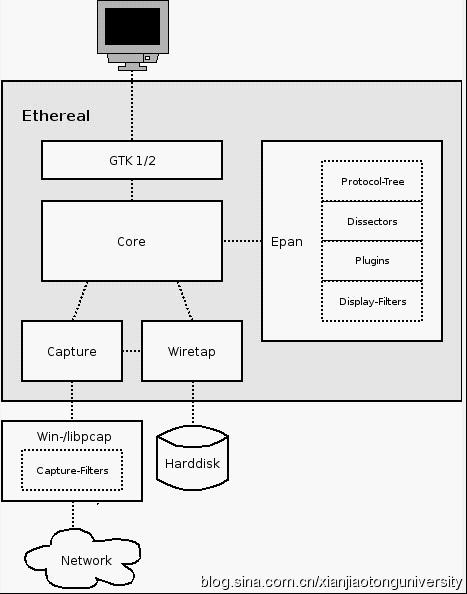
- Win-/libpcap
Wireshark抓包时依赖的库文件,抓包时依赖的库文件
三、wireshark流程分析
初始化
入口代码应该是在gtk\main.c下
- create_main_window
- gtk_main
Wireshark的初始化包括一些全局变量的初始化、协议分析引擎的初始化和Gtk相关初始化,显示Ethereal主窗口,等待用户进一步操作。重点就是Epan模块的初始化。
- Epan初始化:
- tvbuff初始化:全局变量tvbuff_mem_chunk指向用memchunk分配的固定大小的空闲内存块,每个内存块是tvbuff_t结构,从空闲内存块中取出后,用来保存原始数据包。
- 协议初始化:
- 全局变量:
- proto_names
- proto_short_names
- proto_filter_names
以上三个全局变量主要用来判断新注册的协议名是否重复,如果重复,给出提示信息,在协议解析过程中并没有使用。
协议注册:
注册协议:将三个参数分别注册给proto_names、proto_short_names、proto_filter_names三个全局变量中,
注册字段,需要在wireshark协议树显示的报文内容字段。
协议解析表
Handoff注册
将协议与父协议节点关联起来
Packet(包)初始化
全局变量:
frame_handle:协议解析从frame开始,层层解析,直到所有的协议都解析完为止。frame_handle保存了frame协议的handle。在dissect_packet函数相关代码。
data_handle:有的协议无法从frame开始,那么就从data开始。原理同frame。
读配置文件preference
读capture filter和display filter文件,分别保存在全局变量capture_filter和display_filter中。
读disabled protocols文件,保存全局变量global_disabled_protos和disabled_protos中
初始化全局变量cfile
Cfile是个重要的变量,数据类型为capture file,它保存了数据包的所有信息,
取得命令行启动时,参数列表,并进行相应的处理
处理流程
Wireshark初始化完成以后进入实际处理阶段,主程序创建抓包进程,捕包进程和主程序是通过PIPE进行传递数据的,主程序把抓取的数据写入临时文件,通过函数add_packet_to_packet_list将数据包加入包列表。处理时,主程序从列表中选取一个数据包,提取该数据包中的数据填写在数据结构中,最后调用协议解析函数epan_dissect_run进行处理,从epan_dissect_run开始,是实际的协议解析过程,
下面以HTTP协议报文为例,流程如下:
解析frame层
调用函数dissect_frame对frame层进行解析,并在协议树上填充相应字段信息。函数最后会判断是否有上层协议封装,如果有则调用函数dissector_try_port在协议树上查找对应的解析函数,这里函数dissector_try_port根据pinfo->fd->lnk_t查找对应的上层协议处理函数,pinfo->fd->lnk_t值为1,上层封装协议为以太网协议,全局结构体指针变量dissector_handle当前的协议解析引擎句柄置为dissect_eth_maybefcs,至此,frame层解析结束。
解析以太网层
函数call_dissector_work根据dissector_handle调用frame上层协议解析函数dissect_eth_maybefcs对以太网层进行解析,并在协议树上填充相应字段,包括目的MAC地址和以太网上层协议类型等信息。函数最后会判断是否有上层协议封装,如果有则调用函数dissector_try_port在协议树上查找对应的解析函数,这里函数dissector_try_port根据etype查找对应的上层协议处理函数,以太网字段etype为0800的报文是ip报文,上层封装协议为IP协议,全局结构体指针变量dissector_handle当前的协议解析引擎句柄置为dissect_ip,至此,以太网层解析结束。
解析IP层
函数call_dissector_work根据dissector_handle调用以太网上层协议解析函数dissect_ip对以太网层进行解析,并在协议树上填充相应字段,包括版本号,源地址,目的地址等信息。函数最后会判断是否有上层协议封装,如果有则调用函数dissector_try_port在协议树上查找对应的解析函数,这里函数dissector_try_port根据nxt (nxt = iph->ip_p)查找对应的上层协议处理函数,以太网字段nxt为06的报文是TCP报文,上层封装协议为TCP协议,全局结构体指针变量dissector_handle当前的协议解析引擎句柄置为dissect_tcp,至此,IP层解析结束。
解析TCP层
函数call_dissector_work根据dissector_handle调用以太网上层协议解析函数dissect_tcp对TCP层进行解析,包括对TCP头的解析和选项字段的解析,并在协议树上填充相应字段,包括源端口,目的端口,标志位等信息。函数最后会判断是否有上层协议封装,如果有则调用函数dissector_try_port在协议树上查找对应的解析函数,这里函数dissector_try_port根据port查找对应的上层协议处理函数,将源端口和目的端口分别赋值给low_port和high_port,根据low_port和high_port分别匹配上层协议解析函数,port为80的报文是HTTP报文,上层封装协议为HTTP协议,全局结构体指针变量dissector_handle当前的协议解析引擎句柄置为dissect_http,至此,TCP层解析结束。
解析HTTP层
至此wireshark进入应用层协议检测阶段,wireshark解析dissect_http函数中注册的字段,并提取相应的字段值添加到协议树中,应用层的具体解析流程将在下面介绍。HTTP协议具体函数调用过程参见:
四、重要的数据结构
1 | struct _epan_dissect_t { |
五、重要函数理解
1、1
2
3
4
5
6
7
8
9
10
11
12```c
static void
dissect_foo(tvbuff_t *tvb, packet_info *pinfo, proto_tree *tree)
{
col_set_str(pinfo->cinfo, COL_PROTOCOL, "FOO");
/* Clear out stuff in the info column */
col_clear(pinfo->cinfo,COL_INFO);
if (tree) { /* we are being asked for details */
proto_item *ti = NULL;
ti = proto_tree_add_item(tree, proto_foo, tvb, 0, -1, FALSE);
}
}
我们要做的是在分解过程中增加一个子树。此子树将包含此协议的所有细节,因此在不需要时不会使显示混乱。
我们还标记了该协议所使用的数据区域。在我们的例子中,它是传递给我们的全部内容,因为我们假设这个协议没有封装另一个协议。因此,我们使用proto_tree_add_item()添加新的树节点,将其添加到传入的树中,用协议对其进行标签,使用tvb缓冲区中传入的数据,并从0到结束(-1)使用该数据。我们先忽略错误。
2、1
3、```header_field_info
对协议中的每个域都会注册一个header_field_info对象,它描述了此协议域的显示名称,filer中的使用的名称,数据类型以及显示格式等等。
六、代码结构
TAP的理解
TSHARK_TAP_SRC
踪迹分析程序